Note: you can find the question paper on the BIO website
Part A
This problem can be solved using a recursive algorithm:
function is_pat(string: String) -> bool
    if string.len() == 1 then
        return True
    else
        is_pat = False
        for i=0 to string.len() - 2 do
            let (first_half, second_half) = string.split_at(i)
            if NOT min(first_half) > max(second_half) then
                return False
            endif
            if is_pat(reversed(first_half)) AND is_pat(reversed(second_half)) then
                is_pat = True
                break
            endif
        endfor
        return is_pat
endfunction
Part B
I solved this problem by generating all the permutations of ABCD and checking which ones are pats using the algorithm from 1A (you can even do this by hand).
Part C
This question is a bit more involve.
The trick to thinking about this question is to generalise – it’s much easier to think about a “down pat” in the abstract than it is to think about specific down pats and try to draw conclusions about the number of permutations.
First we can simplify the problem – we know that the down pat will be in the form B___A (this is because B comes one letter after A in the alphabet, so it is not possible to put a letter after A because this letter would be after B in the alphabet, and thus not all the characters in the left string would be higher in the alphabet than B). So we can split B___A into ___B and A. For ___B we know that the letter before B will be after B in the alphabet (C or higher) this means that we can only split ___B into ___ and B (because if we had CB, when we reverse this we get BC, and B is not higher than C in the alphabet, so this is not a down pat – the argument can be extended for other letters and greater splits).
We can conclude that we have 24 letters, and we would like to see how many distinct ways we can arrange them that are also valid down pats. We could think about individual permutations, and whether these are valid down pats – this is really messy though!
There is a better way; we can consider the general structure of a given down pat. Let’s think about a 24 letter (valid – this is the crucial assumption; one way that we can define a pat is that for a pat of n letters, we can split it n-1 times in total, before we have just single letters – i.e. we have a binary tree with n-1 nodes with children) down pat – we can split it in 23 different places.
You might find these diagrams useful as a visual aid:
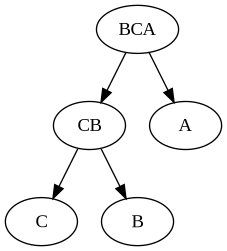
- 3 letters, 3-1 nodes with children
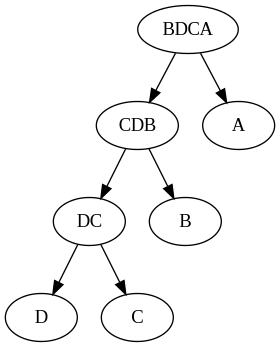
- 4 letters, 4-1 nodes with children
So we could have splits in the form (1, 23), (2, 22), (3, 23), ..., (23, 1) (where each number represents the length of the pat). How does this help us? Well, it means the number of ways this “tree” (think about it – every down pat has two “children” and all of those childen have either two children or no children) can be arranged is:
arrangements(1) * arrangements(23) + arrangements(2) * arrangements(22) + arrangements(3) * arrangemenents(23) + ... + arrangements(23) * arrangements(1).
Hopefully this is looking quite solvable now! But why is this true? Well, let’s think about the first case, where we place one node on the right of the tree, and one node on the left of the tree (see my diagram below).
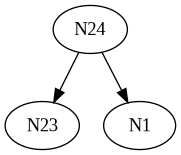
The number of ways that we can rearrange this tree is the number of ways that we can rearrange a tree with one node (i.e. one) times the number of ways that we can rearrange a tree with twenty-three nodes (it’s not immediately obvious how we do this, but note that we can break this problem down recursively in the same way that we did with the 24 letter one). Why? Because for every possible arrangement of the left node, we can have every other arrangement of the right node (in this case, that’s one). I’ve emphasised words in that statement because hopefully they help to make it obvious where this program comes from:
total_options = 0
// for every arrangement of the left node
for i=1 to arrangements(left_node) do
    // we have every arrangement of the right node
    for i=1 to arrangements(right_node) do
        // and this is a distinct arrangement of the whole tree
        total_options += 1
    endfor
endfor
Note that this is equivalent to arrangements(left_node) * arrangements(right_node).
So overall, we have an algorithm that looks a bit like
function arrangements(nodes: nat) -> nat
    // this is our basis case
    if nodes == 1 then
        return 1
    endif

  // we reduce the other cases in terms of the basis case
    total = 0
    for i=1 to nodes - 1 do
        total += arrangements(i) * arrangements(nodes - i)
    endfor
    return total
endfunction
This takes into account all the ways we can build distinct trees.
We are starting with 24 nodes, so the value we want is arrangements(24) (this equals 343059613650). Unfortunately, this function above (although very simple) is too slow as-is. It can easily be sped up using dynamic programming; see a possible solution that runs which I wrote.
The key is never to compute the same value twice – we just save the output value of the function into (for example) a hash table (aka hash map, aka dictionary).
A really easy way to do this in Python is to use the built-in cache decorator (cache documentation) – note that this seems to only exist in Python 3.10 (so you may need to replace cache with lru_cache):
from functools import cache

@cache
def arrangements(nodes: int) -> int:
    if nodes == 1:
        return 1
    total = 0
    for i in range(1, nodes):
        total += arrangements(i) * arrangements(nodes - i)
    return total

print(arrangements(24))
I measured the time taken for each approach:
- With cacheing: 0.0001087188720703125s
- Without cacheing: my computer is still trying to work this out. Update:
it took 24854.752412080765s (ouch) which is about 7 hours!